


 +44-7723-59-8358

On causality in EPR experiments taking Everett interpretation as an example
Received: 12-Jul-2024, Manuscript No. PULJMAP-24-7108; Editor assigned: 16-Jul-2024, Pre QC No. PULJMAP-24-7108 (PQ); Reviewed: 30-Jul-2024 QC No. PULJMAP-24-7108; Revised: 12-Jan-2025, Manuscript No. PULJMAP-24-7108 (R); Published: 19-Jan-2025
This open-access article is distributed under the terms of the Creative Commons Attribution Non-Commercial License (CC BY-NC) (http://creativecommons.org/licenses/by-nc/4.0/), which permits reuse, distribution and reproduction of the article, provided that the original work is properly cited and the reuse is restricted to noncommercial purposes. For commercial reuse, contact reprints@pulsus.com
Abstract
This article points out that in the EPR experiment, there is no causal connection between the two sides. If a causal model wants to comply with the principle of common cause, it will lead to faster-than-light information propagation. Even if non-local latent variables are used as common factors, it does not mean that the measurement results on both sides can influence each other. They are only related to each other, but not corresponding causal relationships. The "statistical correlation" in the EPR experiment does not have a controllable effect, because the results measured on either side are completely random. The experimenter cannot control the other side to produce the results he wants to transmit by manipulating the instrument. The two experimenters can only discover the correlation between each other's data when comparing them afterwards and they cannot use this correlation to transmit information, otherwise the incommunicability theorem will be violated. This paper draws a causal model diagram to analyze the EPR experiment and adopts the Everett interpretation and the quantum line diagram to argue for it. It is shown that the causal paradox in the EPR experiment is caused by the wrong understanding of "measurement" and "collapse" in the Copenhagen Interpretation, and that the Everett Interpretation can be avoided in the interpretation of the EPR experiment if it adopts the Everett Interpretation, which does not have the concept of "collapse". If the Everett interpretation without the concept of "collapse" is adopted, the causal paradox can be avoided in the interpretation of the EPR experiment. In Everett's interpretation, the physical meaning of "measuring" a particle is to entangle the particle with the measuring instrument. When the local particle is measured, it will only be entangled with the local instrument, so there is no non-local interaction. The state of the particle does not change in any way because the particle on the other side is measured. No matter who measures first on the left or right, there will be no influence on each other. There will be no effect of the result of the first measurement on the result of the later measurement through superluminal action and there will be no paradox that overturns the order of cause and effect.
Keywords
EPR experiment; Everett interpretation; Quantum Mechanics; Causality; Quantum circuit
Introduction
Einstein believed that "the belief in an external world, independent of the perceiving subject, is the basis of all natural science." Until the 20th century, scientists believed that this external world had some substantial states waiting to be discovered and the purpose of science was to improve the knowledge that tells people how the world is composed and evolves. Although the scientific method requires observation and measurement to achieve this goal, we believe that the physical "reality" described exists independently of the means of operation [1,2]. Einstein also said: "Physics is an attempt to understand reality conceptually and it is independent of the things being observed."
Einstein summarized these ideas as "local realism", which he described in his 1935 paper "Can the description of physical reality in quantum mechanics be considered complete?" He designed a thought experiment, which is called the " EPR experiment" in this article. By testing the physical behavior of the correlation exhibited by two quantum entangled particles, the EPR experiment highlights the contradiction between local realism and the completeness of quantum mechanics. Therefore, these arguments are often called "EPR paradoxes", which are important criticisms of the Copenhagen interpretation of quantum mechanics in the form of a thought experiment paradox [3].
In the framework of classical mechanics, random events are not truly random. If you have enough information, you can accurately deduce the results. For example, where does the probability of rolling a dice come from? Because the dice will have many complex collisions with the table and ordinary people have no idea about these collisions and cannot predict the results. They can only generally predict that each side has the same probability of facing up. Suppose we carefully study what materials the dice and the table are made of, the elasticity of the materials and other factors and know how the dice will bounce up after colliding with the table at a certain angle, how it moves in the air, etc. Based on this knowledge, we can accurately predict which side of the dice will face up after it stops. As long as we have the position, speed, speed, direction of rotation and the direction of each side of the dice at the moment of throwing the dice, rolling the dice is no longer an uncertain event and does not need to be described by probability. If these complex factors are taken into account, we can abandon the probability theory and accurately predict which side of the dice will face up. For the probability theory of dice, these factors are "hidden" variables. Einstein believed that the probabilistic nature of quantum mechanics was also caused by our lack of understanding of quantum states. Through these hidden variables, people can get rid of probability and accurately predict the results of quantum measurements [4].
Philosophers have had many debates about the EPR paradox. Hans Reichenbach believes that "the principle of causality is in no way compatible with quantum physics."
Judea Pearl points out: "The word 'causality' is not essential to quantum theory. Causation at the quantum level follows its own rules and intuitions." Olivier Costa de Beauregard proposed that the EPR experiment can be explained by a causal model: Starting from the measurement of one particle, the causal influence propagates backwards in time until the two particles interact directly earlier and the causal relationship propagates backwards through time to affect the measurement result of the other particle.
Richard Healey said: "There is no consensus among philosophers as to whether the EPR experiment establishes a causal link between these measurements. […] And physicists are generally reluctant to accept that there is a causal link between space-like events, including the measurements in the EPR experiment." Brian Skyrms points out: "We have to say that in the EPR experiment, the two measurements of 'spin down on the left' and 'spin up on the right' are causal, forming a rather strange closed causal chain consisting of two spatially separated events. 'Spin down on the left' is a necessary and sufficient condition for 'spin up on the right' and the correlation is statistically positive."
Bas van Fraassen logically argued that the EPR correlation does not conform to any causal model. His reason is that any causal model that attempts to describe the EPR correlation must actually be a deterministic model and any such deterministic model is bound to violate Bell's inequality. Arthur Fine believes that there can be no superluminal influence between the two wings of the EPR experiment and that any causal connection between the two quasi-space-separated wings in the EPR experiment would contradict the foundations of quantum mechanics. Michael Redhead attempted to prove that quantum mechanics and special relativity could coexist peacefully by pointing out that according to the assumption that only time-correlated events can establish causal links, no direct causal relationship can be established between the outcome events of the EPR experiment [5].
This article will analyze the possible causal relationship in the EPR experiment and refute Costa de Beauregard 's view that the EPR experiment does not need to be explained by time reversal. It also refutes Brian Skyrms' view that the entangled particle pairs on the two wings cannot have a causal relationship, which means that any local hidden variable theory cannot be applied to the EPR experiment and according to the special theory of relativity, the causal relationship of superluminal speed is also invalid in physics.
Huw price mentioned: "It is generally accepted that EPR correlations do not allow signals to be sent faster than the speed of light, but the question of whether there is a causal effect between Bell pairs is not so simple. Whatever the nature of the effect, part of the concern seems to be that special relativity has shown that any spacelike (i.e., superluminal) effect will lead to a kind of reverse causality from the perspective of some inertial reference frame. This therefore raises huge problems for the interpretation of the EPR experiment, including the paradox of causality and soon."
This article points out that it is incorrect to claim that the EPR experiment has overturned causality. The EPR experiment only overturns local reality, but not causality. Moreover, although the results of measurement operations in quantum mechanics are uncertain, the evolution of quantum states (Schrödinger equation) is still certain. John von Neumann pointed out that there are two completely different ways of quantum state evolution in quantum mechanics: (1) Wave function collapse; (2) Dynamic evolution of quantum state according to Schrödinger equation. The former is discontinuous and non-unitary the latter is continuous and unitary. The difference between these two quantum state evolutions comes from the difference in the system: The system undergoing unitary evolution is an isolated quantum system, that is, the quantum system has no energy and material exchange with the outside world; while the quantum system undergoing wave function collapse interacts with the measurement system.
Hasok Chang and Nancy Cartwright proposed a view that they believe that a causal explanation can be given for the superluminal correlation revealed in the EPR experiment. They also believe that the special theory of relativity does not prohibit the existence of space-like causality of superluminal propagation in the EPR experiment. They proposed a causal model for the superluminal correlation in the EPR experiment. In their model, the causal relationship is preserved through direct propagation between the two wings. Because if the setting of the measuring instrument on one side is changed, it will affect the probability of the measurement result on the other side, so there is a causal connection in the EPR experiment. If the result of the electron measurement does not really affect the measurement result of the positron, we cannot explain the correlation between the two sets of data. Iain Martel pointed out that as long as we allow non-local hidden variables to be common factors, we can design a common cause model that allows the EPR experiment to satisfy the causal Markov condition [6].
However, Wesley Charles Salmon pointed out that all attempts to explain the EPR experiment by appealing to the "hidden variable theory" have encountered serious difficulties and I firmly believe that the hope of finding a satisfactory "hidden variable theory" to explain the EPR experiment is slim. van Fraassen also believed that the long-distance simultaneous correlation in the EPR experiment violated the Reichenbach common cause principle Van Fraassen the proof is as follows:
Given an interacting composite state (A+B), the value of the corresponding observable is c, after which the composite system separates into distant subsystems A and B. Alice measures subsystem A and obtains the possible value of the observable quantity as {ai}.
This paper argues against giving a causal relationship to the long-distance correlation revealed in the EPR experiment. The results of the EPR experiment are similar to tossing a shared synchronous coin. There is a special coin that makes the second person tossing the coin always see the opposite of the first person, but if there is no classical communication (such as by calling to notify), neither person can know whether they are the first or the second person tossing the coin. In addition, the causal relationship should meet the explanatory condition: The cause can explain the effect. We cannot say that the measurement results on the left and right sides of the EPR experiment can explain each other. They are just related to each other, but not a corresponding causal relationship.
This article supports Lev Vaidman's view that the lesson we should learn from Bell's inequality is not that quantum mechanics requires some kind of superluminal action at a distance, but that it makes us believe in the existence of parallel worlds. This article will explain that the causal paradox of the EPR experiment originates from the misunderstanding of wave function collapse. If the Everett interpretation is adopted, the essence of measurement is quantum entanglement and the "measurement process" is a continuous unitary evolution (reversible), abandoning the non-unitary process (irreversible) that measurement will lead to collapse in the Copenhagen interpretation. In this way, the causal paradox can be avoided when explaining the EPR experiment.
If we abandon locality and retain reality, then quantum entanglement will have the paradox of "spooky action-at-a-distance“, because in fact, if the particle does not have a definite spin, there is no need for "action-at-adistance“. If we admit that the probability predicted by quantum mechanics is an inherent part of the nature of the particle (that is, there is no " reality" in quantum mechanics and all experimental results can only be expressed as probability distribution), then the EPR experiment can only predict the correlation between two particles, rather than the result of one particle changing its state because another particle is measured.
Similarly, the possible value measured by Bob is {bi}, where i=1, ... ,n , where n is the degree of freedom of the quantum system.
The probability of the two experimenters measuring any state is 1/n: P (aj/ c)=1/n, P (bj/c)=1/n
And because aj and bj are entangled, when Alice measures aj, Bob must also measure bj, so:
P (aj & bj/c)=P (aj/c)=P (bj/c)=1/n
This is contrary to the Reichenbach common cause principle, because if ACB forms a conjunctive fork and event C is the common cause of event A and event B, then the probabilities of these three events will satisfy:
P (aj & bj/c)=P (aj/c) * P (bj/c)=1/n2
only when n=1, which is the case of determinism.
Bohm 's version EPR experiment
In 1957, David Bohm proposed a scheme to implement the EPR experiment, which some people call the EPR-Bohm experiment. Consider a π0 meson decaying into an electron-positron pair:
π0 → e − + e +
π0 meson is zero, so the conservation of angular momentum requires that the electron-positron pair be in a singlet entangled state:
(↑ − ↓ + − ↓ − ↑ +)/√2
If the electron's spin is up, the positron's spin must be down and vice versa. In any particular π0 meson decay, quantum mechanics cannot predict which spin combination you will get, but it does specify that the spin measurements of the positron and electron pairs will be correlated. And on average, the probability of getting each of the two combinations is 50%.
Suppose we let the electron and the positron fly a distance in opposite directions. If the experimenter on one side measures that the electron's spin is up, he will immediately know that the positron's spin on the other side is down. This is nothing new to realists. Realists believe that at the moment the π0 meson decays, the electron has been fixed to spin up (the positron's spin is down), but quantum mechanics cannot tell us. This kind of mutual correlation also exists in the classical world. For example, now there are two balls, one black and one white, randomly placed in two boxes. You and your friend each take a box to a distant place and open it. When you see that there is a black ball in the box, you immediately know that he has a white ball. No one will doubt that this violates any physical law. Everything is in line with daily life experience. So for a long time, physicists did believe that there was no difference between the two super-distance correlations of spin singlets and red and white balls. We now know that there is a big difference between the two, because color is a "classical variable". For classical systems, we can only detect this pre-selected variable. For quantum systems, we can temporarily decide to change the measurement of other variables of the two balls.
But the Copenhagen school believes that the spin of particles is uncertain for example, if the measurer suddenly changes his mind and changes the measurement tool to test which particle is red in the "red and green" setting, he can immediately know that the other particle will be measured as green if the first particle is measured as red. Even if the measurement variable is temporarily changed, the conclusion that they were entangled before the measurement can still be obtained.
"Before measurement" (not because of insufficient ability or unknown, it is uncertain). And it is the measurement operation that causes the electron's wave function to collapse, and at the same time "instantly affects" the spin of the distant positron. Einstein believed that such ghostly action at a distance was absurd and violated the limitation of the special theory of relativity that information transmission cannot exceed the speed of light. He was convinced that the view of the Copenhagen school was untenable, that electrons and positrons always have a certain spin and that you cannot be sure only because the current theory of quantum mechanics is incomplete.
EPR is based on the principle that no information can travel faster than the speed of light, a principle known as locality. You might think that the collapse of the wave function might not be instantaneous, but this would lead to a violation of angular momentum conservation, because if we measure the spin of the positron before the news of the collapse of the electron wave function reaches the distant place, there will be a 50% chance that both the positron and the electron spin up. Therefore, the wave function cannot collapse at a finite speed, but collapses instantly.
Hasok Chang’s causal model for the EPR experiment
Hasok Chang gave the following example to illustrate that the cause and effect of classical mechanics cannot be used to describe quantum mechanics: When we heat a piece of metal, electrons are emitted from the surface of the metal and we can detect the electrons with a detector at a certain distance. We only know that the electron appears on the detector because it is generated by the metal source, but how does it get from the metal source to the detector? Quantum mechanics cannot answer this question. The wave-particle duality shows that we cannot regard electrons as particles moving on a continuous trajectory and located in a specific area at any given time, but must be described by wave functions that spread throughout space.
When an electron is detected at a certain point, the entire wave function that was originally scattered in a vast area of space suddenly gathers together at a speed faster than light and appears only at that point. Therefore, Hasok Chang believes that whether the collapse of the wave function requires time is still an unsolved question, but at least we know that this time is too short to measure. Gao Shan also explored whether superluminal signal transmission can be carried out through the collapse of the wave function.
Wave function collapse is incompatible with relativity and the wave function collapse caused by measurement can exceed the speed of light. Therefore, there are causal laws in the quantum world that are different from those in the classical world and quantum mechanics seems to allow distant events to be related to each other.
Hasok Chang pointed out the wave function collapse of quantum mechanics is a phenomenon unknown when relativity was invented, so if we have to give up one of the theories of relativity and quantum mechanics in order to explain the EPR paradox, then we tend to give up relativity. Einstein insisted: "If two particles are space-like separation, then measuring one particle will not affect the other particle", but this insistence was falsified by Bell and is also contrary to experimental results.
Materials and Method
Based on this, Hasok Chang designed a causal model for the EPR experiment
- The EPR electron-positron pairs acquire a common factor λ at the splitting source π0, which enables them to have a causal influence at some point in the future. The existence of a common factor λ is necessary, otherwise the measurement results of the EPR particle pairs will not be correlated. The factor λ is encoded in the quantum state and if there is no external interference, λ will be retained after the EPR particle pair leaves the splitting source.
- Measuring one of the particles will produce a purely random result.
- Due to the existence of the common factor λ, the measured particle can immediately transmit the information of the measurement result to its partner particle at a distance.
- Then measure the partner particle and the result will be closely related to the result of the first measurement. If one side is spin-up, the other side must be spin-down. The reason why these two measurement results are closely related is that they are prepared from a common split source, the π and there is a common factor λ encoded in the quantum state, so they can pass information to each other through λ."
Finally, Hasok Chang concluded: "The key to the inconsistency between relativity and quantum mechanics in dealing with measurement issues is that the wave function collapse is instantaneous, that is, the wave function that permeates the entire space will collapse to a point in an instant. No matter which side of the EPR positron-electron pair the experimenter measures first, the particles on both sides collapse at the same time, which makes superluminal causal relationships possible. The EPR experiment refutes the argument that 'no information can travel faster than the speed of light'. The measurement phenomenon in quantum mechanics exceeds the scope of application of special relativity. As long as we are willing to seriously deal with the measurement process in quantum mechanics, we can indeed make a causal explanation for the EPR experiment."
From the perspective of special relativity, the above EPR experimental causal model has two flaws
First, according to point 3, "the measured particle can immediately send information about the measurement results to a distant partner", this implies that one of the particles needs to be measured "before" the other particle. However, it is meaningless to talk about the order of two events separated by space-like separation, because by appropriately changing the reference system, we can always turn the "later" event into the "front" event.
If there is a certain information that can be transmitted faster than the speed of light, then this will violate causality, because any superluminal transmission will be regarded as propagating in the reverse direction of time in another reference frame after the reference frame transformation (because in special relativity, several distant clocks are synchronized by sending light signals, so a signal running faster than the speed of light in one reference frame will be equivalent to transmitting a signal to the past in some other reference frames). However, if no information is transmitted, for example, the phase velocity of mechanical waves can exceed the speed of light. If the time sequence of two events cannot be clearly defined, can we still call it "causality"? When we talk about causality, we actually assume that the cause must appear "before" the result. The cause must happen first and then it will cause the result to happen.
Secondly, this model needs to assume that the propagation speed of causal information can exceed the speed of light, but according to the special theory of relativity, superluminal information transmission is impossible. In the framework of the special theory of relativity, causality can only exist within the light cone and all causal relationships must be connected in the light cone, that is, time-like events, so that the temporal order principle can be preserved. Any valid information cannot be transmitted faster than the speed of light, because if an event has not even transmitted the light it emits to me, then I have no other way to know that this event has occurred, so this event cannot affect me.
In my opinion, the causal model proposed by Hasok Chang is just an interpretation of quantum mechanics similar to Bohm's pilot wave theory, in which the common factor λ is some kind of non-local hidden variable. Next, we will demonstrate whether the pilot wave theory can transmit causal information.
Using pilot wave theory to explain the EPR experiment
In an EPR experiment, it is assumed that the experimenter is able to change the spin orientation that he wants to measure (for example, by rapidly changing the angle of the magnetic field in the measuring instrument) while a set of entangled, electron-positron pairs is in a state of flight and spacelike separation.
Support the pilot wave theory believe that the state of the measuring instrument must be contained in the "quantum potential" of the pilot wave (the state of the quantum potential is similar to the common factor λ in Hasok Chang's model). The interaction between the navigation wave and the particle can only be one-way. The navigation wave is the active party and the particle is the passive party. There is no reverse effect of the particle on the navigation wave. The navigation wave "shows" the curvature of its amplitude to the particle, thereby "telling" the particle how to move. The size of the quantum potential has nothing to do with the vibration energy carried by the navigation wave. When the navigation wave "acts" on the particle, it does not use its own energy. This kind of action that cannot exchange energy and can only be one-way does not meet the definition of the concept of "interaction" in physics. Bohm believes that this is a mechanism based on information transmission, so it is also called "information potential" and the information transmitted by the quantum potential occurs at superluminal speed. Quantum potential is a non-local global quantity. If each particle must obtain information from this global quantum potential to determine its own mode of movement, then it must first be recognized that information can be transmitted in space without being limited by the speed of light. It should be pointed out here that the information and causal relationship defined by the special theory of relativity cannot exceed the speed of light. It is assumed that information transmission needs to be based on energy exchange. In fact, the special theory of relativity only limits the speed of energy transmission to not exceed the speed of light. The new mechanism introduced by Bohm's theory does not rely on energy exchange, so it is not limited by the speed of light.
Therefore, when the angle of the instrument's magnetic field rotates, this change will change all parts of the quantum potential, including the measurement results that can be shown by guiding distant particles and the propagation speed of this change is superluminal (Figure 1).
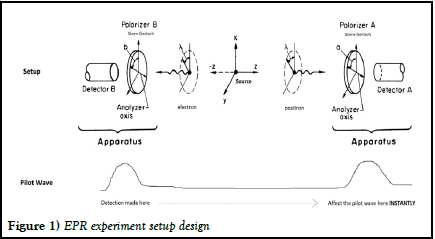
Figure 1) EPR experiment setup design
So can we use navigation waves to send signals and transmit information at superluminal speeds?
The initial position of the particle on the pilot wave is unknown and we can only write it as a probability distribution, which needs to satisfy Born's rule: The distribution is proportional to the square of the amplitude of the wave function (all quantum mechanical interpretations must derive this point or explicitly write it into their axioms so that they are consistent with observations). Therefore, the no communication theorem of quantum mechanics still holds true in pilot wave theory, because the statistics of the initial particle distribution will "prevent" you from transmitting superluminal information through pilot waves. In other words: Since you can only detect the structure of the pilot wave by measuring particles and these particles have initial conditions that just cover up superluminal information transmission, you will never be able to transmit superluminal information through quantum entanglement.
The initial probability distribution of the pilot wave is crucial. It adds the probability distribution of the initial position of the particle at the right position and with the right value, thus covering up all information that may carry superluminal signals. The "coincidence" of the initial statistical data just covers up the potential superluminal effect. Many physicists believe that if it is necessary to resort to such "coincidences" to explain quantum phenomena, this actually shows that there are flaws in the pilot wave theory. This theory is complicated and difficult to convince. The quantum potential field permeates the entire universe, allowing it to always be fully aware of its surroundings. No matter if there is any change in the experimenter or the particle in a certain place, the ubiquitous quantum potential will sense this change and transmit this change to all places in the universe in an instant, thereby guiding each particle to change its behavior pattern. Bohm assumed that a particle has a definite trajectory but stipulated that due to the random perturbations of hidden variables, we can never observe such a trajectory. This violates the principle of Occam's razor: What is the difference between saying that something exists, but it is absolutely unobservable and not existing? The quantum potential field permeates the entire universe, allowing it to always be fully aware of its surroundings. No matter if there is any change in the experimenter or the particle in a certain place, the ubiquitous quantum potential will sense this change and transmit this change to all places in the universe in an instant, thereby guiding each particle to change its behavior pattern. Bohm assumed that a particle has a definite trajectory but stipulated that due to the random perturbations of hidden variables, we can never observe such a trajectory. This violates the principle of Occam's razor: What is the difference between saying that something exists, but it is absolutely unobservable and not existing?
In addition, since the pilot wave equation itself is not covariant, it is difficult for the Bohm theory to be integrated with the existing field theory, which makes the promotion of the Bohm theory very limited.
Next, let’s go back to Hasok Chang’s EPR model
Factor λ between the positron and electron pairs that allows them to "talk " to each other, if the experimenter cannot control the content of the conversation between the particles, then there is no way to transmit information through this pair of particles. Consider the case where the magnetic field angles on both sides are the same, there is a perfect anti-correlation between the measurement results, but when we make a measurement, we cannot control the measurement result. This is the pure randomness of the quantum measurement process. Even if the information of the measurement result can be transmitted to the other end through the common factor λ, this is information that is not controlled by the experimenter, so it is not a valid signal for the experimenter monitoring the measurement result at the other end. This is also required by the noncommunication theorem. Even if there is a superluminal potential field, people still cannot use it to transmit information, otherwise it will violate the special theory of relativity.
Specifically, a person operating an electron detector has no way to use his measurement to send a signal to the positron detector on the opposite side, because he cannot control his own measurement results. Although the experimenter on the left can decide whether to make a measurement, the experimenter on the right is measuring at the other end of the spacelike partition and the right side does not know whether the electron on the left has been measured. Data collection is carried out separately at both ends and both sides get a string of {+1, -1, -1, +1, …} completely randomly. The experimenter on either side cannot use the measurement to actively encode (for example, the experimenter on one side adjusts the instrument to ensure that {+1, -1, -1, +1, …} will be measured for binary encoding). Only after the measurement is completed, the results obtained at both ends are compared to find the correlation. So, in fact, people cannot use this common factor λ to transmit information, because what is measured on both sides is completely random. The speed of information transmission still cannot exceed the speed of light!
The result of Bell's theorem shows that there is no local hidden variable theory, but it still leaves open the possibility of non-local hidden variable theories. Even Bell himself believed that there are objective non-local connections in the world, although this violates Einstein's special theory of relativity. Bell's theorem requires the assumption that the properties of a quantum system are independent of the properties of any future measurements that may be made on the system, which means that hidden variables are independent of later measurement operations. Like Einstein, Bell's intuition about quantum theory has a strong realist character. He was attracted to the idea of an objective world that exists independently of human observers and tended to think that quantum mechanics only gives us an incomplete description of this objective reality. Therefore, Bell, like those physicists who still adhere to realism, also prefers Bohm 's pilot wave interpretation.
If it is necessary to introduce superluminal information transmission to explain the collapse of the wave function, this further proves that the wave function collapse is an imperfect theory. In this article, I will explain that if the Everett interpretation is used to explain the EPR experiment, then the paradox of superluminal information transmission will not occur.
Causal modeling in EPR experiments
Hasok Chang concluded that any possible direct causal connection in the EPR entangled pair must be transmitted at superluminal speed. However, this paper proposes that there is no term in the Hamiltonian of the EPR entangled pair that represents the physical interaction between two distant particles, so there can be no superluminal connection in the EPR experiment. Due to the limitations of special relativity, there can be no causal connection between two space-like events, so any causal model cannot explain the distant correlation.
David Lewis proposed that a valid causal relationship should at least meet the following points:
- The cause is an absolutely sufficient condition for the result, ceteris paribus.
- The cause is a necessary condition for the result when other conditions remain unchanged.
- Precondition (counterfactual version of 2): Without a cause, there can be no effect.
- Causation as explanation: Causes can explain effects.
- Statistical theory of causality: Under the conditions of relevant background factors, causes and effects have a positive statistical correlation.
- Manipulability: If the cause variable is manipulated in the experiment, the result variable will also be affected accordingly.
- There is a transfer of energy-momentum from cause to effect.
The causal relationship. Any variable, given its parent node, is statistically independent of its non-descendants.
Next, we will test the above points separately in the EPR experiment.
Is there a causal relationship between the entangled EPR pairs on the left and right sides? Can we say that when the experimenter "measured" the spin-up behavior on the left side, it "led" to the spin-down measurement on the right side? Will the operation on one side "affect" the result on the other side?
Given the premise that the measurement result on one side is spin-up, the conditional probability of measuring the spin-down on the other side is 100%. Therefore, Lewis 's 1 and 2 points are both satisfied. When the left side measures spin-up, the right side must measure spin-down. In other words, the necessary and sufficient condition for the right side to measure 100% spin-down is that the left side measures spin-up.
However, the EPR experiment does not satisfy point 3. It cannot be said that the measurement results on the left and right can explain each other. They are only related to each other, but not a corresponding causal relationship.
We cannot say that the measurement result on the left "causes" the measurement result on the right. The two results may only be related. This phenomenon is the "constant conjunction" proposed by Hume. Constant conjunction means that when we see that the measurement result on the left always "causes" the measurement result on the right, what we actually see is that the left is always "constantly connected" with the right. Therefore, we have no reason to believe that one thing really causes another thing. There is no causal relationship between the two things.
In 1982, Alain Aspect proved Bell's theorem experimentally and he also won the Nobel Prize in Physics in 2022. Therefore, it is confirmed that quantum mechanics is purely random at its foundation. There is only a statistical correlation between the positron and electron pairs in the EPR experiment, but there is no interaction or causal relationship. There is no instantaneous superluminal effect between the positron and electron pairs and the local hidden variable theory is wrong.
Point 4 If the EPR experiment is repeated many times, when a string of {+1, -1, -1, +1, …} is recorded on one side, the other side must be the opposite {-1, +1, +1, -1, …}. Although the data collected by the two experimenters seem to be completely random, when they compare them after the measurement, they will find that the data obtained by each other are completely symmetrical. So the data on both sides have a positive statistical correlation.
However, this "statistical correlation" does not have a controllable effect, because the results measured on either side are completely random in the eyes of the experimenter on that side. If the causal structure is like this: Mag_L → Mag_R, then I can influence Mag_R by manipulating Mag_L, but there is no such control in the EPR experiment. The experimenter on the left cannot control the right side by manipulating his measuring instrument to make the desired result appear. The experimenters on both sides can only find that their data are correlated when they compare the data after the experiment and they cannot use this correlation to transmit information.
For example, when a coin is tossed, the coin randomly appears on the front and back sides. Although the front and back sides are statistically related, for example, if there is an observer above and below the coin, when the observer above sees the result of one side, he will immediately know what the other side should be. However, this does not mean that the observer above the coin can tell the observer below through some operation and they cannot establish instant superluminal communication. Therefore, the EPR experiment does not meet the controllability of point.
Point 6 can be tested together with the finite speed condition. If the measurement operation on the left is the cause of the measurement result on the right, then there needs to be a transfer of energy-momentum from the left to the right. However, according to the non-communication theorem, quantum entanglement does not allow information to be transmitted at superluminal speeds, so it is not satisfied.
Moreover, in Hasok Chang's model, the time order criterion is not preserved, so we cannot call it a "causal" model. The term "superluminal causality" is very contradictory to the special theory of relativity, because the causality in the special theory of relativity is interpreted as describing that certain events occurring in space-time can affect other events and there can be no causal relationship between two space-time separated events, because the theory of relativity prohibits the propagation of information faster than the speed of light.
Finally, let’s test the common cause principle. The causal structure of the EPR experiment is Mag_L → Det_L ← QS → Det_R ← Mag_R. We use the variable QS to represent the quantum state. The angle settings of the left and right Stern-Gerlach magnetic fields are represented by the variables Mag_L and Mag_R and the detector's measurement results are simulated by the binary (up or down) variables except for the detection of magnetic field, there are no other factors around that can affect the causal relationship. The only possible common source of the measurement results on both sides is the quantum state of the source. Therefore, if the local hidden variable theory is adopted, the EPR experiment obviously violates the common cause principle. According to the direction of the arrows in the causal diagram, there is no causal relationship between Det_L and Det_R (Figures 2 and 3).
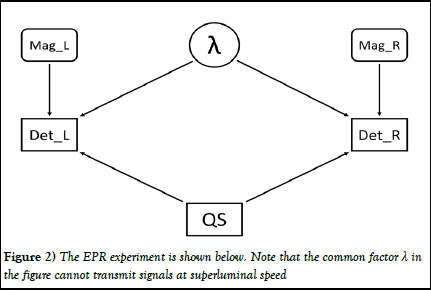
Figure 2) The EPR experiment is shown below. Note that the common factoλr in the figure cannot transmit signals at superluminal speed
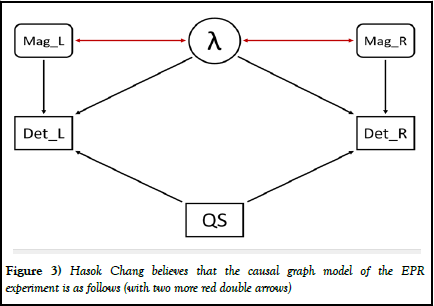
Figure 3) Hasok Chang believes that the causal graph model of the EPR experiment is as follows (with two more red double arrows)
When the magnetic field angle of the instrument rotates, this change will transmit the "information" to the particle on the opposite side at superluminal speed instantaneously through the common factor λ (which is a non -local hidden variable). In order to make the EPR experiment conform to the common cause principle, Hasok Chang's model mistakenly assumed that measurement operations on the left will instantly affect the measurement results on the right, but this violates the finite speed condition.
In the EPR experiment, the measurement results are space-like correlated, so there is no direct causal relationship between the two wings, which means that any local hidden variable theory cannot be applied to the EPR experiment and according to the special theory of relativity, superluminal causality is also invalid in physics. Therefore, this paper points out that the EPR experiment overturns local reality and if an EPR causal model wants to comply with the common cause principle, then it will violate the finite speed condition.
Describing the EPR experiment using the Everett interpretation
This section points out that the causal paradox in the EPR experiment actually stems from a misunderstanding of the collapse of the wave function. If the Everett interpretation is adopted, the essence of measurement is quantum entanglement and the "measurement process" is a continuous unitary evolution (reversible), abandoning the non-unitary process (irreversible) that measurement will lead to collapse in the Copenhagen interpretation. In the framework of the Everett interpretation, the wave function will always only have a unitary evolution and there is no collapse, so the causal paradox can be avoided when explaining the EPR experiment.
Using the Bohm version of the EPR experiment as an example, the π0 meson decays into a singlet entangled state of a positron-electron pair:
It can also be equivalently expressed as:

We agree that the arrow on the left represents an electron flying to the left and the arrow on the right represents a positron flying to the right. In the following text, for the sake of simplicity, the (+/−) signs in the subscripts are sometimes ignored, which does not affect the conclusions we want to derive.
Results and Discussion
Now suppose the experimenter on the left rotates the magnetic field of the measuring instrument by a certain angle. Write down the new quantum state. When one spin in the singlet system rotates by an angle, the quantum state of the system changes accordingly. Let's use "R" to represent the rotation operation on the electron spin on the left. The effect of this rotation on the electron's spin-up and spin-down states can be expressed as follows
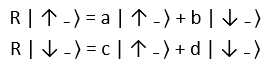
Where a, b, c, d are complex numbers representing superposition coefficients. Their specific values will depend on the rotation angle and rotation axis, so we do not need to write out their specific values here.
Substituting the quantum state of the rotated electron into the singlet state of the EPR positron-electron pair, the new state of the system |ψ′⟩ becomes. Expand it and we get, expanding and rearranging further gives.
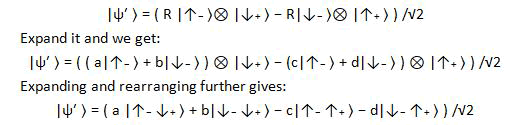
The new quantum state of the EPR system after one of the experimenters rotated the magnetic field of the measuring instrument by a certain angle.
Now consider two experimenters measuring the spin states of two particles respectively and write down the spin states and the observer's pointer before and after the measurement. Here we use Everett interpretation to derive, in which measurement does not collapse the wave function of the particle, but entangles the particle with the quantum state of the measuring instrument. Let's consider a situation where two experimenters measure the spin in the z direction respectively. We denote the states of the observer's pointer as | Pu⟩ and |Pd⟩, which correspond to the pointer states of measuring spin up and spin down respectively.
Before measurement, the combined state of the EPR system state and the observer pointer can be written as.

Here, |ψ'⟩ is the new quantum state of the EPR system after one of the experimenters rotated the magnetic field of the measuring instrument by a certain angle and |P0 P0⟩ represents the initial state of the two pointers, indicating that no measurement has been performed.
After measurement, the system’s combined state evolves into a superposition of all possible measurement outcomes, each entangled with the corresponding pointer state. The state after measurement | Ψafter⟩ can be written as.

In | ↑↓ ⟩ | Pu Pd⟩ The physical meaning is: the instrument on the left measures that the electron spin is upward (the pointer is in the state |Pu⟩), and the instrument on the right measures the positron spin down (the pointer is in the state |Pd⟩). | Ψafter⟩ The four terms in this superposition state represent four possible combinations of positron and electron spin states and the positron and electron spin states are entangled with the pointer state of the instrument.
In Everett's interpretation, the physical meaning of " measuring " a particle is to entangle the particle with the measuring instrument to form |↑⟩Left ⊗ | Pu ⟩Left, when the local particle is measured, it will only be entangled with the local instrument. The measurements on both sides are performed independently, so there is no non-local effect. The state of the other particle on the right will not change because the experimenter on the left measured the particle on the left. This is the biggest difference between using the Everett interpretation to describe the EPR experiment and using the Copenhagen interpretation. There is no ghostly action at a distance. No matter who measures first or later on the left or right side, they will not affect each other. There is no possibility that the result of the first measurement will affect the result of the later measurement through superluminal action, and there will be no paradox of overturning the causal order.
Physicists of Einstein and Bohr's generation all adopted the Copenhagen interpretation, so their thinking was limited to using "collapse" to explain "measurement". Therefore, they came to the absurd conclusion that "the experimenter on one side made a measurement first, causing the quantum state of a particle to collapse first and this collapsed 'information' would be transmitted to the other side at superluminal speed, causing the particle on the other side to collapse as well. " The common factor λ proposed by Hasok Chang played the role of a non-local hidden variable, transmitting this collapsed" information" between the two sides at superluminal speed.
Describing the EPR experiment with quantum circuits
This section uses a quantum circuit diagram to illustrate that there is no information transfer between the two sides of the EPR experiment. The design of the experimental device is still as shown in Figure 1. The experimenters on the left and right sides are Alice and Bob, and the two polarizers are represented by R. The Stern-Gerlach magnetic field can rotate at different angles θ/φ, so the structure of Figure 1 can be drawn as the following quantum circuit diagram (Figure 4).
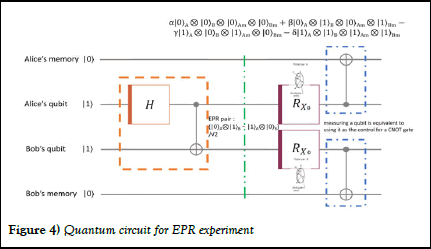
Figure 4) Quantum circuit for EPR experiment
First initialize two qubits:

Applying the Hadamard gate to qubit A yields:

Applying CNOT gates to qubits A and B yields:

This creates an EPR entangled pair between Alice and Bob (the orange box in the figure above).
Next, the experimenters on the left and right rotated the Stern-Gerlach magnetic field at different angles, which are shown as red boxes in the quantum circuit diagram. Rxθ, Rxφ To represent, it means that the two polarizers rotate by angles θ and φ respectively and the new entangled quantum state is obtained as follows.

In α, β, γ, δ are complex numbers representing the superposition coefficients, whose specific values will depend on the rotation angles θ, φ, we don't need to write out their specific values here.
Finally, the two blue boxes in the figure represent the two experimenters measuring the two particles. In Everett's interpretation, the essence of the "measurement process" is quantum entanglement, which will not decoherent into the environment, so CNOT can be used to represent the measurement in Everett's interpretation (the notes will explain why this is possible). The top and bottom two lines represent the data measured by Alice and Bob using the instruments, recorded as Alice 's memory (Am) and Bob 's memory (Bm).
The measurement results are:
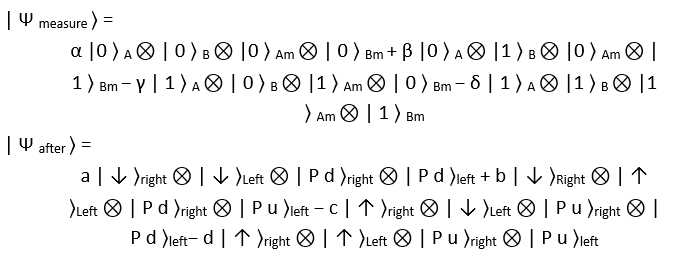
If we ignore all superposition coefficients and assume that Alice is the experimenter on the right and Bob is the experimenter on the left, |0 ⟩ represents spin down | ↓ ⟩ and |1 ⟩ represents spin up | ↑ ⟩. The two memory states correspond to the pointer states respectively. It can be seen that the results obtained by describing the EPR experiment using quantum circuits are the same as those obtained by describing it using Everett interpretation.
From the quantum circuit diagram, we can see that after the EPR entangled pair is prepared (green dotted line to the right), there is no connection between the two experimenters Alice and Bob. There is no connection between the two upper lines and the two lower lines. This means that no matter what operations Alice does later (rotating the polarizer magnetic field or performing CNOT operations), it will not affect the results on Bob 's side. Since we use CNOT in the quantum circuit diagram to represent the measurement in Everett interpretation and it does not involve the collapse of the overall EPR state, the state of the particle on Bob 's side will not change due to Alice's measurement of the particle.
In quantum circuit diagrams, parallel logic gates are mathematically represented by tensor products. Based on the mixed product property of tensor products three sets of quantum circuit diagrams are equivalent (Figure 5).
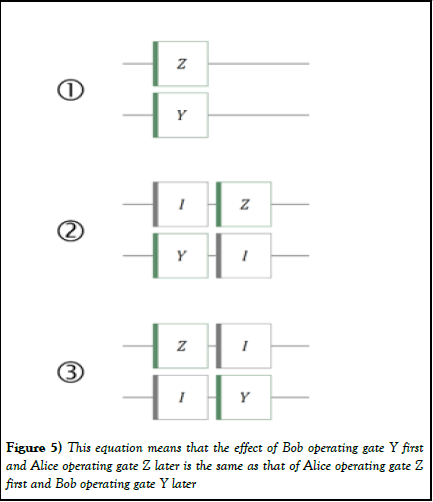
Figure 5) This equation means that the effect of Bob operating gate Y first and Alice operating gate Z later is the same as that of Alice operating gate Z first and Bob operating gate Y later
This means that no matter which of the two experimenters rotates the polarizer magnetic field or performs the CNOT operation first, the results are exactly the same and will not affect the other party. There are no timerelated parameters in the quantum circuit diagram, so no matter which side performs the CNOT operation first, the left and right sides will not affect each other and the two sides have no way of knowing whether the other side has performed the CNOT operation. There is no possibility that the result of the first measurement will affect the result of the later measurement through superluminal action.
This also shows that there can be no causal relationship between the two wings of the EPR experiment, because if we assume that Alice 's previous operation is the "cause" that leads to the "result" of Bob's subsequent measurement then we can also say that Bob's previous operation is the "cause" that leads to the "result" of Alice's subsequent measurement. This forms a paradox of causal loop and it is impossible to point out which of the two is the cause and which is the result, which does not meet the third point of David Lewis ' causal relationship (Figure 6).
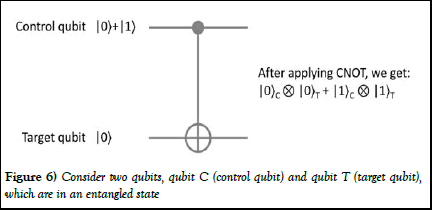
Figure 6) Consider two qubits, qubit C (control qubit) and qubit T (target qubit), which are in an entangled state

measure qubit C and find it in state |0 ⟩ , then the joint state of the two qubits collapses to |0 ⟩C ⊗ |0 ⟩T , that is, the CNOT gate does not actually work and does not perform the NOT operation on the target qubit. If qubit C is measured and found to be in state | 1 ⟩ , then the joint state collapses to |1 ⟩C ⊗ |1 ⟩T , that is, the CNOT gate will flip the state of the target qubit to |1 ⟩ .
This shows why the effect of measuring the control bit C is equivalent to using it as a control for the CNOT gate: The measurement result affects whether the target bit T undergoes a NOT operation (this is the effect of the CNOT gate). If the control bit C is measured as |0 ⟩, no operation is performed on the target bit T; if the control bit C is measured as |1 ⟩, a NOT operation is performed on the target bit T. This quantum entanglement caused by the "measurement process" fits the framework of Everett's interpretation.
The state of the target bit is equivalent to the pointer state of the instrument. The physical meaning of the pointer state is the result measured by the instrument. |0 ⟩C ⊗ |0 ⟩Det + |1 ⟩C ⊗ |1 ⟩Det This means that particle C is in state |0 ⟩C and the instrument measures |0 ⟩Det in Everett’s interpretation, the “measurement process” can be described by the quantum entanglement between particles and instruments. In fact, measurement is to couple the measured particle with a macroscopic system (the measuring instrument). If the particle’s bit is |0 ⟩C, the instrument displays |0 ⟩Det; If the particle's bit is |1 ⟩C, the instrument shows |1 ⟩Det, its working principle is the same as that of CNOT gate.
Conclusion
This paper points out that in the EPR experiment, the measurement results are space-like correlated, so there is no direct causal connection between the two entangled particle pairs, which means that any local hidden variable theory cannot be applicable to the EPR experiment. Moreover, according to the special theory of relativity, superluminal causality is invalid in physics. If an EPR causal model wants to conform to the common cause principle, then it will violate the finite speed condition.
This article refutes Nancy Cartwright, Hasok Chang and Iain Martel believe that a causal explanation can be given for the long-distance correlation revealed in the EPR experiment, and refute their view that special relativity does not prohibit the existence of space-like causality of superluminal propagation in the EPR experiment.
Even if non-local hidden variables are taken as common factors, the EPR experiment is still not a valid causal relationship. Causal relationships should satisfy the explanatory conditions: The cause can explain the result. We cannot say that the measurement results on the left and right sides of the EPR experiment can explain each other. They are just related to each other, but not a corresponding causal relationship.
EPR experiment is not controllable, because the results measured on either side are completely random in the eyes of the experimenter on that side. The experimenter on the left cannot control the results he wants to convey on the right side by manipulating his measuring instrument. The two experimenters can only find that their data are correlated when they compare the data after the experiment. They cannot use this correlation to convey information, otherwise it will violate the non-communication theorem.
Finally, this article explains that the causal paradox in the EPR experiment is actually caused by a misunderstanding of "measurement" and "collapse" in the Copenhagen interpretation: It is believed that measuring the particle on one side first will cause collapse and then the information of the collapse is "transmitted" to the other side at superluminal speed, thus causing the particle on the other side to collapse instantly. If an interpretation without the concept of "collapse" is used to examine this experiment, such as in the
Everett interpretation, the wave function always has only unitary evolution and the non-unitary collapse is abandoned, the causal paradox can be avoided when explaining the EPR experiment.
In the framework of Everett 's interpretation, there will be no superluminal conclusion that " the measurement operation on one side can affect the measurement result on the other side at a distance“. The statistical distribution of the measurement results on the left is completely independent of anything done on the right. In theoretical calculations, the independence of the measurement results of the two experimenters is guaranteed by the fact that their observations are commutable with those of others; in quantum field theory, locality is expressed by the fact that field operators at space-like separation points are commutable with each other, which also ensures that the propagation speed of any causal influence cannot exceed the speed of light.
References
- Beebee H, Hitchcock C, Menzies PC, et al. The Oxford handbook of causation. 2009.
- Bell M, Gao S. Bell M, et al. Quantum nonlocality and reality: 50 years of Bell's Theorem. 2016.
- Bohm D, Aharonov Y. Discussion of experimental proof for the paradox of Einstein, Rosen, and Podolsky. Phys Rev. 1957;108(4):1070.
- Clauser JF, Horne MA. Experimental consequences of objective local theories. Phys Rev. 1974;10(2):526.
- Einstein A, Podolsky B, Rosen N. Can quantum-mechanical description of physical reality be considered complete?. Phys Rev. 1935;47(10):777.
- Gao S. Is superluminal signaling possible in collapse theories of quantum mechanics?. Found Phys. 2023;53(5):87.